In one paragraph
Same drum of 365nm UV fluorescent ink, same press, same plate — swap the paper and the fluorescence goes dull, or the colour shifts. It is one of the most common misdiagnoses in security printing, and nine times out of ten the ink gets the blame.
The real cause usually sits in the substrate. Fluorescent whitening agents added to paper and film also glow under a 365nm lamp. The very light you use to excite the ink excites the background as well. The legibility of a 365nm UV security feature depends on the brightness difference and the hue difference between the ink’s fluorescence and the substrate background — not on the ink’s absolute brightness. A whitening agent lifts the background brightness and shifts its hue, the gap narrows, and the fluorescence reads as “dull” or “off-colour”.
Two fixes follow from that, and both restore the gap: switch to a substrate free of whitening agents, or put down a layer of ordinary colour ink that contains none — separating the substrate from the UV light on the way in, and from the observer on the way out. This article works through the chain: which substrates are high risk, how to screen a substrate with a UV lamp in 30 seconds, and what each fix costs you — including one trap that catches almost everyone.
1. First, the physics: fluorescence is judged by contrast, not brightness
To see why a whitening agent can destroy a security feature, it helps to be precise about how UV fluorescence is actually seen.
1.1 Excitation and emission are two separate steps
The fluorescent pigment in a UV ink works by absorbing ultraviolet and emitting visible light. 365nm photons strike the ink film, the pigment molecules absorb that energy, and re-emit it at a longer wavelength — red, yellow, green, blue or white. Remove the lamp and the emission stops instantly. That is why fluorescence is a “only visible under the lamp” effect.
The critical point: what the eye sees is never the ink itself, but the light the ink emits. Everything else follows from that.
1.2 The eye compares two things
Under a UV lamp the observer’s field of view contains two contributions: light emitted by the fluorescent ink, and light coming off the substrate — reflected lamp light plus, where present, fluorescence from additives in the substrate itself. The eye compares them:
- Brightness difference: how much brighter the printed area is than its surroundings. The larger the difference, the more the pattern “pops”.
- Hue difference: how far the ink’s fluorescent colour sits from the background colour. The closer they are, the more the two merge.
Both decide legibility together. This is why an ink can keep exactly the same absolute fluorescence and still become invisible: the background got brighter.
1.3 A counter-intuitive consequence
The whiter the substrate, the better it looks in daylight — and the noisier it gets under 365nm.
Whiteness under white light comes from high reflectance. Whiteness under UV comes from a whitening agent converting ultraviolet into blue light. On many paper grades those two come from the same additives. A substrate engineered for high whiteness is often precisely the substrate loaded with whitening agent.
2. Fluorescent whitening agents: why they land exactly on 365nm
2.1 What the additive does in paper
Fluorescent whitening agents — also written FWA or OBA (optical brightening agent) — are organic compounds that absorb ultraviolet and emit blue-violet visible light. The grades most used in papermaking are stilbene (stilbene disulfonate) derivatives.
Pulp and coating binders are naturally yellowish. A whitening agent converts invisible UV into light around 430–460nm and adds it to the reflected spectrum, complementing the yellow cast. The sheet looks whiter and brighter. This is optical brightening, not bleaching: nothing coloured has been removed, the sheet is simply borrowing ultraviolet light to look better.
2.2 Spectral overlap is the root cause
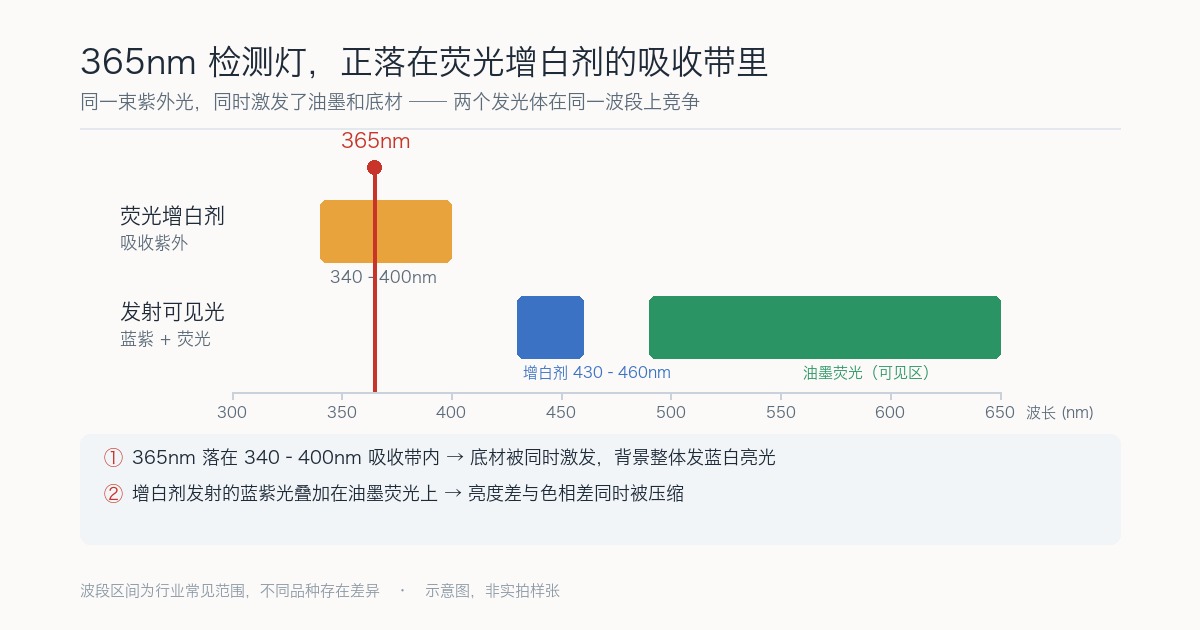
The main absorption band of a whitening agent sits in the long-wave ultraviolet, broadly 340–400nm depending on the chemistry, with emission broadly around 430–460nm. The security industry’s standard inspection wavelength is 365nm — almost dead centre of that absorption band.
In other words: the beam you use to excite the ink excites the background too. This is not ink and substrate “interfering” with each other; it is two emitters competing in the same band. The ink emits, the substrate emits, and the eye receives the sum.
2.3 Why the industry uses so much of it
Because it is cheap, effective, and in many cases required:
- Whiteness targets: high-brightness coated, woodfree, copy paper and white board reach their numbers this way;
- Compensating yellowing: recycled and mechanical pulp is yellowish, and a whitening agent pulls the visual white point back;
- Coating appearance: coating colour with whitening agent makes the printed sheet look cleaner and more premium;
- White film: white PE/PP and pearlised films also use it to hit brightness targets.
So it is not a marker of cheap material. It is a normal part of the process. The problem is narrower and more specific: these materials are inherently unsuitable as a base for 365nm UV fluorescent security printing.
3. What the interference actually looks like, by fluorescent colour
The damage is not spread evenly. How much a given fluorescent colour is “swallowed” depends on its hue relationship to the background blue-violet.
| Fluorescent colour | Severity | What you actually see | What to do |
|---|---|---|---|
| White | Very severe | White fluorescence sits in the same blue-white region as the whitening agent’s emission. The two merge almost completely: you see one bright area with no pattern edge | Change the substrate; or mask with a whitening-agent-free white or pale ink |
| Blue | Severe | Same hue family as the background. Brightness contrast flattens, edges blur, and the pattern is unreadable at distance | Substrate change first; masking second |
| Green | Moderate | Background blue adds on top, so the green reads cool and grey with reduced saturation | Masking usually sufficient, but verify saturation on press |
| Yellow | Moderate to mild | Blue contamination makes the yellow look grey and slightly green; contrast drops but the outline survives | Masking works; keep the masking colour away from blue |
| Red | Least affected | Largest hue distance from a blue-violet background, so it stays recognisable — though brightness contrast still drops | Masking generally enough; also the safer choice on high-whiteness stock |
There is a practical corollary here: if the substrate cannot be changed and you are stuck with high-whiteness stock, a red or orange fluorescent ink will hold up far better than white or blue. Hue difference is the part of the contrast that is hardest to erase.
4. Which substrates are risky: a reference table and a 30-second test
| Substrate | Risk | Why |
|---|---|---|
| High-brightness coated paper, woodfree, copy paper | High | Whitening agents used in both stock and coating to hit brightness targets |
| High-brightness white board (SBS/FBB) | High | Top coating commonly contains them; the brighter the grade, the more is used |
| High-brightness self-adhesive facestock (coated, mirror) | High | Facestock and back coating may both carry them |
| White PE/PP film, white pearlised film | High | Used to lift brightness, and completely invisible to the eye |
| Standard coated paper, pale tints | Medium | Grade dependent — must be checked under the lamp |
| Natural / cream offset, uncoated bulky | Low | Usually no whitening agent; warmer shade |
| Kraft, black board, dark stock | Low | Darkness already masks it, and no brightness target |
| Aluminium foil, metallised film | Low | Metal layer blocks UV; background does not emit |
| Clear PET/PVC/BOPP | Low (verify) | Most clear films carry none, but some “ultra-clear” grades may — check under the lamp |
| Heavy dark solid printed base | Low | Already masking, provided the masking ink itself is free of whitening agent |
One warning: you cannot judge this by how white the material looks. Some natural stocks look creamy and contain nothing; some sheets look like ordinary white and go uniformly blue under the lamp. The only reliable test is the lamp.
4.1 The 30-second test
- Take an unprinted area of the actual substrate — same batch, same side that will be printed.
- Dim the room, or work inside a cardboard box. Ambient white light badly distorts the judgement.
- Hold a 365nm UV lamp 20–30cm away, as close to perpendicular as you can.
- Look at the sheet as a whole: a clear blue-white glow across the area means whitening agent; almost no glow, just a faint dull violet, means comparatively safe.
- Compare against a piece of kraft or natural stock. Side by side the difference is obvious — far more reliable than trying to remember a standard.
4.2 The most common mistake: your lamp may not be 365nm
A large share of cheap “UV torches” and banknote checkers on the market are 395nm, and some are simply white LEDs with a violet tint. They leak a lot of visible violet, so every sheet looks bright and you conclude the substrate is loaded with whitening agent. Turn it around and use a 395nm torch to assess a 365nm ink, and the fluorescence looks weak — so now the ink gets blamed instead.
How to tell: a true 365nm lamp with a filter shows almost no visible violet. On white paper you see mostly the brightness of the fluorescent material, not the beam itself. If the torch throws an obvious violet patch on blank paper, it is not a judging tool.
5. Fix one: change to a substrate free of fluorescent whitening agent
The thorough approach. The background does not emit, contrast is at maximum, and colours stay pure.
5.1 When it fits
- New job, material not yet fixed, so there is room to choose;
- The customer has not mandated a specific stock, or will trade appearance for security performance;
- The fluorescent colour is white or blue — the two most sensitive to background, and the most expensive to mask;
- High security level, where a single check under the lamp has to be unambiguous.
5.2 How to execute it
Ask for both a sample and a written statement. Get the mill or converter to confirm in writing that the grade contains no fluorescent whitening agent — then verify it yourself under 365nm. Written statements and physical stock disagree more often than people expect, especially after a production batch change.
Directions worth prioritising: natural or cream offset, uncoated bulky, kraft, black and dark boards, aluminium foil and metallised film, plus clear films confirmed free of the additive.
5.3 The limits
Material is often specified by the brand’s design department, so changing it means an approval cycle and may alter shelf appearance. Work already printed cannot be changed at all. Cost and lead time may move. And some designs simply require a very white sheet, which is in direct conflict with “no whitening agent”. Those constraints are exactly why fix two exists.
6. Fix two: mask the substrate with ordinary colour ink
The workhorse solution when the material is locked. The principle is a double block, and both halves have to be in place:
- Block the UV going in: the colour ink layer absorbs and scatters 365nm so it cannot reach the whitening-agent-bearing layer;
- Block the blue coming out: even if the substrate is still excited, the blue-violet emission is stopped by the ink layer and never reaches the observer.
Half a job is no job. Block the UV but let blue through, and the background still reads bright. Block the blue but leak UV, and the substrate keeps glowing behind the film — invisible from one angle, exposed the moment the viewing angle changes or a pinhole appears.
6.1 Three conditions that must all be met
① Solid coverage, no show-through. The masking layer has to be a full 100% solid. Any white gap, tint, reversed-out type or fine dot will leak both UV and blue. Watch the design specifically where pale panels or white space already exist — those areas are effectively unmasked.
② Thick enough, and even. UV penetrates further than visible light, so a thin colour film will not stop it. Dark masks are efficient; pale masks need considerably more film thickness for the same result. Evenness matters as much as thickness, because a thin patch anywhere becomes the weak point.
③ The masking ink itself must contain no fluorescent whitening agent. This is the trap, and it deserves its own section.
6.2 The trap: white ink contains whitening agent too
For brightness and opacity, ordinary white ink (titanium dioxide based) frequently carries a fluorescent whitening agent. Use it as a base coat and you have moved the substrate’s problem onto the surface of the ink film. Under 365nm the base coat glows blue-white, and the fluorescent ink printed on top is just as unreadable as before.
What makes it so insidious is that in daylight the white base looks perfect — clean, bright, entirely normal. The failure only appears when someone finally checks in a dark room.
How to test: print a solid patch of that white ink on plain paper, dry it properly, then inspect under 365nm. A blue-white glow means reject; a faint dull violet with no glow means it is usable.
How to solve it: specify a whitening-agent-free white or pale ink from your supplier, or move to a dark mask (deep blue, charcoal, black, a dark spot colour). Dark systems generally need no whitening agent and are therefore safer by construction.
6.3 This is not the same problem as infrared masking
We have written before about masking IR-absorbing inks (see combining IR-absorbing and IR-transparent inks and multiband IR-absorbing ink from 780 to 980nm). The two are often conflated, but the failure mechanisms differ, and so does the masking logic:
| Item | Infrared masking | UV fluorescent masking |
|---|---|---|
| Problem being solved | Organic colour pigments are near-transparent in the near IR, so the eye cannot see the ink-layer difference | The substrate itself emits under 365nm, lifting the background |
| What is blocked | Visible light returning toward the observer | UV going in and blue-violet coming out (both directions) |
| Key metric | Near-IR absorption and scattering | UV blocking plus a mask that does not itself fluoresce |
| Most common failure | Carbon-black-type pigment swallows the pattern along with the background | A white base coat that contains whitening agent |
| Inspection | IR viewer or IR camera | 365nm lamp, viewed in the dark |
In one line: infrared masking blocks the light coming back; UV masking has to block the light going in and the light coming out.
6.4 Three things to re-qualify after printing
The fluorescent ink is no longer going onto paper; it is going onto a colour ink film. The substrate has changed, so re-confirm:
- Adhesion: ink-to-ink adhesion is not the same as ink-to-paper. Re-run the tape test;
- Drying and overprinting: printing fluorescence over an under-cured mask causes mottling and poor anchorage;
- Fluorescent film weight: too thin and the emission is weak, too thick and downstream processing suffers. Tune thickness and brightness together, not one at a time.
7. Choosing between the two fixes
| Situation | Recommendation |
|---|---|
| New job, material open, white or blue fluorescence | Fix one — change the substrate; the ceiling on performance is highest |
| Material specified by customer or design, cannot change | Fix two — colour masking, with the white ink trap in mind |
| Work in progress already printed | Fix two only |
| High-whiteness stock with white fluorescence | Change the paper first; even after masking, white may not read strongly enough |
| Dark substrate, any fluorescent colour | Usually nothing needed — but confirm the dark ink carries no whitening agent |
| Long reading distance, must be obvious at a glance | Fix one, or combine both |
| Cost sensitive, high volume, material locked | Fix two, and accept the brightness ceiling |
In practice the two are often combined: a whitening-agent-free substrate, plus local reinforcement with dark solids in the critical areas. Where budget allows, that is the most robust arrangement.
8. The third option: can 254nm avoid the problem?
Whitening agents absorb mainly in the long-wave ultraviolet and respond far less at 254nm. On a substrate that does contain them, a 254nm fluorescent scheme is therefore usually “quieter” — a darker background and better contrast. In many real cases this holds up.
But it has costs, and it is not a general substitute:
- Safety: 254nm is short-wave UV (UVC), with a materially higher risk to eyes and skin than 365nm. Inspection needs protection and is unsuitable for casual open-environment checking;
- Hardware: short-wave lamps cost more and last less than long-wave lamps, and are far less common on the plant floor;
- Substrate self-fluorescence: some substrates show weak fluorescence from cellulose or other components under short wave, which must be measured;
- The ink must match: a 365nm pigment under a 254nm lamp usually will not excite at all. Wavelength mismatch defeats a perfect ink.
So 254nm is best positioned as the third route when the substrate cannot be changed and masking is impractical — and only when the ink itself is designed for 254nm.
9. Verification before the run, and acceptance after it
9.1 The cardboard box test: cheapest and most accurate
Put the proof inside a cardboard box, aim the lamp through the opening, and look through a second small opening — or simply use a dark room. It is far more accurate than inspecting in a brightly lit pressroom. Ambient white light dilutes fluorescent contrast, and a large share of “looked fine in the plant, failed at the customer” disputes start exactly there.
9.2 Side-by-side from the same batch
Print one patch with the same ink on stock that contains whitening agent and one on stock that does not, then inspect both together. The difference is immediately visible — and it is the most persuasive thing you can put in front of a customer. No explanation of the physics required; two samples side by side do the work.
9.3 Fix the viewing conditions
Write these four items into the acceptance sheet so neither side argues from a different setup:
- Lamp model and nominal wavelength — confirm 365nm, not 395nm;
- Working distance (20–30cm recommended);
- Angle of incidence (as close to perpendicular as possible);
- Ambient light level (dark room, or the box method).
9.4 Retain signed samples
Both parties keep a signed sample noting substrate brand and batch, ink batch number, print date and viewing conditions. When a batch is disputed, the retained sample is the only evidence that counts. Fluorescence is strongly batch-sensitive — a new paper batch from the same mill can change it — so retain the substrate along with the print.
10. Frequently asked questions
Why does the same UV fluorescent ink look dimmer on a different paper?
Because visibility depends on the brightness and hue difference between the ink’s fluorescence and the substrate background, not on absolute ink brightness. A substrate containing fluorescent whitening agent emits blue-violet light under 365nm, lifting the background. The difference shrinks and the fluorescence reads as dim. The ink has not changed; the background has.
What is a fluorescent whitening agent, and why does it affect UV security printing?
An FWA (or OBA) is a compound that absorbs ultraviolet and emits blue-violet visible light, used in papermaking to raise apparent whiteness. Its main absorption band sits broadly at 340–400nm and its emission broadly at 430–460nm — while the industry’s standard inspection wavelength is 365nm, right inside that absorption band. The inspection lamp therefore excites both the ink and the substrate, two emitters compete in the same band, and pattern contrast drops.
How do I check whether a paper or film contains a whitening agent?
Take an unprinted area, work in a dark room or a cardboard box, and hold a genuine 365nm lamp 20–30cm away, close to perpendicular. A clear blue-white glow across the sheet means it contains whitening agent; almost no glow with only faint dull violet is comparatively safe. Put a piece of kraft or natural stock beside it as a reference — the contrast is far easier to judge. Note that cheap “UV torches” are usually 395nm and leak visible violet, which causes misjudgement.
Can I still print 365nm UV fluorescent ink on paper that contains a whitening agent?
You can, but performance degrades, and how much depends heavily on the fluorescent colour. White is effectively lost, blue is badly weakened, green and yellow are moderate, and red is comparatively robust. If the substrate is fixed, choose red or orange fluorescence, or lay down a solid mask in whitening-agent-free ink before printing the fluorescent layer.
Does a white base coat solve the whitening agent problem?
Not necessarily — and this is the most common single cause of failure. Ordinary white inks often contain fluorescent whitening agent to lift brightness, so the base coat itself glows blue-white under 365nm. You have moved the problem from the substrate to the surface of the ink film. Specify a white ink confirmed free of whitening agent, and verify a solid patch under 365nm before the run.
Why is the fluorescence still weak after a white base coat?
Three candidates, in this order: the white ink contains whitening agent and the base coat is emitting; the mask is too thin or not a true 100% solid, so UV still gets through and blue still comes back; or the fluorescent layer itself is too thin to emit enough. Check the white ink first, then the coverage, then the fluorescent film weight.
Changing the substrate or adding a mask — which is better?
Changing to a whitening-agent-free substrate has the higher ceiling: the brightest, purest fluorescence, with the biggest gain on white and blue. But material is often specified by the customer or design team, which makes change expensive. Masking is flexible and leaves the material alone, suiting locked specifications or existing work in progress, but it consumes a print unit and must solve the white-ink trap. Where requirements are demanding, combine both.
Can 254nm short-wave UV avoid whitening agent interference?
It reduces it substantially, but it is not equivalent. Whitening agents absorb mainly long-wave UV and respond much less at 254nm, so the background is quieter. But 254nm is UVC, with higher risk to eyes and skin and a need for protection; short-wave lamps cost more and last less than long-wave lamps; and the ink must itself be designed for 254nm — a 365nm ink under a 254nm lamp usually will not excite.
Is dim fluorescence an ink quality problem?
Usually not. Rule out three things first: reprint the same ink batch on a substrate known to be free of whitening agent and compare; confirm the lamp really is 365nm rather than 395nm; confirm the viewing environment is dark enough. Only then look at ink batch, film weight and drying. Substrate-driven dimming is the single most frequent misdiagnosis in this area.
How do I qualify a job before the production run?
Do two things. First, print side-by-side patches with the same ink on stock with and without whitening agent, and inspect them together in the dark. Second, put the viewing conditions into the acceptance sheet — lamp model and wavelength, distance, angle, ambient light — and have both parties sign and retain samples. Retain the substrate with the sample, because a new paper batch alone can change the result.
11. About SJH Ink
Shenzhen SJH Ink manufactures security and specialty printing inks: UV fluorescent (invisible) ink, IR-excitation and IR-absorbing inks, thermochromic ink, optically variable ink, glow-in-the-dark ink, scratch-off ink, plus packaging and card ranges. For substrates that contain fluorescent whitening agents we can supply matched masking recommendations and whitening-agent-free white or pale inks.
We generally ask customers to send the actual substrate with the enquiry. The spread in performance across substrates is usually larger than customers expect. Once the stock arrives we screen it under 365nm first, then tune the formulation to the chosen substrate and issue printed proofs — so the problem surfaces at sampling rather than after the production run. Free printed proofs are available for press trials.
See the UV fluorescent white ink demonstration video for the effect in practice, the five-series selection guide for choosing a chemistry, and UV invisible ink versus ordinary ink for how detection differs. For cigarette packaging, see UV invisible ink in cigarette carton security. Tel: +86 13510998453.