The short answer
Used on its own, IR-absorbing ink can be read by an infrared device, but when the ink film is thin it still leaves a faint trace that a careful observer can pick out under normal light – so its covertness has a ceiling. To hide it far better: first print the hidden text or pattern in IR-absorbing ink, then overprint an IR-transparent ink as a masking layer. Under normal light the masking layer blocks the pattern underneath; under an IR camera the infrared light passes straight through the masking layer and strikes the IR-absorbing pattern below, so the hidden text or image appears. The result is content that only shows up with matching IR equipment – essentially invisible to the naked eye.
Shenzhen Sojhonink Co., Ltd. supplies both the IR-absorbing ink and the IR-transparent ink this combination needs, and supports screen printing, offset printing and UV inkjet printing with formulations customised to substrate, wavelength and equipment.
1. What is IR-absorbing ink – and why is it “not covert enough” on its own?
IR-absorbing ink is a functional ink that strongly absorbs or blocks infrared light in a specified band. Under an IR camera or reader matched to that band, the printed area reflects or emits a different amount of IR energy from its surroundings, so it shows up clearly in one of two ways: black (absorptive mode – the pattern sits dark against a bright background) or bright white (read against a dark background). This is why it is widely used for invisible codes, covert marking and anti-counterfeiting traceability.
Its weakness is not the IR effect – it is the visible trace. To make IR absorption strong and the signal stable, a certain film thickness and pigment loading are normally required, and the thicker the film, the more the ink’s own hue can be noticed under normal light. Make the film thinner and the visible trace fades: at a film thickness in the single-digit microns (for example below 8μm), the colour under normal light is already very faint, but because the IR functional material itself carries some hue, a careful observer may still make out the outline of the text or pattern.
In other words, IR-absorbing ink alone offers “limited” covertness. It defeats ordinary optical reading, but not necessarily a person holding the printed item and studying it closely in good light. For high-end security work, that is often not enough.
Putting the two easily confused terms side by side makes the rest much easier to follow:
| Dimension | IR-absorbing ink | IR-transparent ink |
|---|---|---|
| In the specified IR band | Strong absorption / blocking | High transmission |
| Under an IR camera | Forms a dark pattern with clear contrast against the background | Produces almost no pattern of its own – effectively lets infrared through |
| Role under normal light | Forms the text or pattern to be hidden | Masks the layer below so the eye cannot read it |
| Role in the combination | The information itself (hides it) | The masking layer (covers it) |
| Typical printing process | Screen printing / UV inkjet / offset | Matched to the masking requirement |
2. How the combination works: a masking layer you cannot read through
The idea is straightforward – cover the IR-absorbing pattern with a layer that hides it in visible light but is almost no obstacle to infrared. That layer is IR-transparent ink (also called IR-transmitting ink).
On the substrate the combination forms a three-layer structure:
- Substrate: paper, film or card;
- IR-absorbing pattern layer: carries the hidden text, image or code – this is the information itself;
- IR-transparent masking layer: sits on top, masking in visible light and letting infrared through.
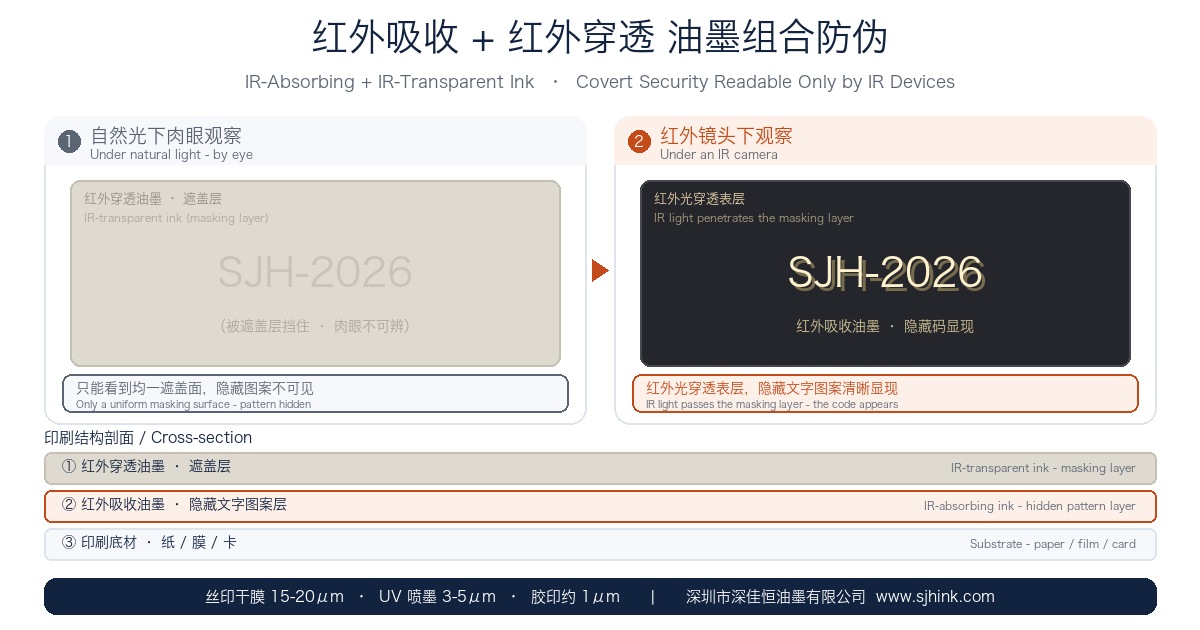
The difference between those two views is exactly the point:
- Under normal light: the masking layer is opaque in the visible range, so the IR-absorbing pattern below is hidden; the eye sees a uniform surface and cannot tell there is text underneath.
- Under an IR camera: the IR-transparent ink transmits the detection band with little attenuation, so IR light reaches the absorptive pattern below, contrasts against the background, and the hidden text “lights up”.
3. Why the masking layer fools the eye but not infrared
The key is that a material’s response in visible light and in the infrared can be designed independently. Visible light spans roughly 380-780nm, while common IR detection bands sit at 850nm, 940nm, 980nm and beyond, in the near-infrared. At the material level these are different interaction ranges.
So a material can be engineered so that:
- In visible light – it has enough opacity or scattering to hide the IR-absorbing pattern below, so the eye sees one uniform, continuous surface;
- In the specified IR band – it transmits infrared with high efficiency, so IR light passes through the masking layer almost without loss;
- The IR-absorbing ink below – strongly absorbs that same band. One transmits, the other absorbs, giving high contrast and a clearly visible pattern.
This is the opportunity created by band selectivity: the masking layer does not hide the information – it hides it from the eye only, while letting infrared through. Match the band characteristics of the two layers and the wavelength of the reader, and you get “unreadable by eye, obvious under IR”.
4. Five points for choosing the IR-transparent ink
- Match the transmission band to the reader: first establish whether detection uses 850nm, 940nm, 980nm or another band. Both the masking layer and the absorbing layer must be designed for that band – “it’s infrared” is not a specification.
- Opacity under normal light: the higher the opacity, the harder the underlying pattern is to spot in visible light. Balance this against the masking layer’s own colour so it harmonises with the packaging design or substrate.
- Compatibility with the layer below: the two layers must not dissolve into, bleed through or lose adhesion to each other, or you will get mottled patterns and masking failure.
- Process and curing compatibility: the masking layer’s printing method and curing conditions must be compatible with the layer it overprints and with the overall production process.
- Registration: the masking layer must precisely cover the pattern layer with enough margin; registration error directly undermines covertness.
5. Three printing methods and film thickness: where the difference lies
The same IR-absorbing ink printed by different methods gives very different dry-film thickness, and therefore different IR absorption, covertness and throughput. This is a common reason why “someone else’s IR security works better than mine”.
| Printing method | Dry film thickness (approx.) | IR absorption | Covertness under normal light | Throughput | Typical use |
|---|---|---|---|---|---|
| Screen printing | 15-20μm | Thick film, high absorption, strong IR response, easy to achieve functionality | Relatively weak – the thicker film is more visible | Medium | Functional applications such as IR ranging; cases needing a strong IR signal |
| UV inkjet printing | 3-5μm | Moderate thickness, balancing absorption and jettability | Strong – barely noticeable under normal light | High, variable data | Product traceability, item-level codes, invisible QR codes |
| Offset printing | About 1μm | Very thin film, comparatively gentle absorption | Best when properly designed | High, suited to long runs | High-volume fixed text and patterns; best covertness when combined with an IR-transparent masking layer |
Behind this table is a rule that runs through everything above: film thickness, IR response and visible trace trade off against one another.
- Thicker film: stronger IR absorption and a more stable functional signal, but a more visible trace under normal light;
- Thinner film: fainter visible trace and better covertness, but a weaker IR signal, which places higher demands on the ink formulation, the reader and the printing precision.
That is precisely why an IR-transparent masking layer effectively “backstops” covertness on the thin-film side: it lets you choose a thin film with moderate absorption (easier to hide), then covers the last trace of visible marking with the masking layer.
6. Choosing the process by use case: a decision guide
Selection can be reduced to three questions:
| What you mainly need | Recommended process | Why |
|---|---|---|
| A strong functional IR signal (IR ranging, sensing, a specific reflectance requirement) | Screen printing | Thick film and high absorption make the function easiest to achieve; a relatively visible trace can be tolerated or corrected with a masking layer |
| Item-level codes, variable data, high efficiency (traceability, invisible QR codes) | UV inkjet printing | Moderate film, strong covertness, variable data and high-speed production |
| Maximum covertness with high-volume fixed patterns | Offset printing + IR-transparent masking layer | Thin film, faint trace; covertness is best once the masking layer is added |
If all three needs exist at once – for example a product that needs both a functional mark and a traceability code – you can also use different processes on different areas of the same printed item, letting functional and covert information each do their job.
7. Typical applications
- Premium tobacco, spirits, pharmaceutical and cosmetics packaging: overlay a covert IR pattern on the packaging; with a masking layer it can be almost imperceptible to the eye, raising the security level substantially;
- Tickets, certificates and ID cards: scenarios with high requirements for covertness and uniqueness;
- Product traceability and item-level coding: UV-inkjet-print an invisible IR code and cross-verify it with a visible QR code to resist copying and channel diversion;
- Covert marking on electronics and automotive parts: print hidden batch or serial numbers on components for anti-counterfeiting and full-process traceability;
- Brand protection and channel control: where you need “an invisible layer on top of the visible security”;
- Multi-layer security systems: combine with UV fluorescent ink, OVI optically variable ink, thermochromic ink and others for verification by eye, UV and IR.
8. What to watch when designing a combination security scheme
- Registration is make-or-break: the masking layer must fully cover the pattern layer with margin, or the edge will expose the IR-absorbing pattern and give the hidden information away;
- Control thickness and uniformity: too thin and the underlying hue shows through; too thick and it can affect total film performance and drying. Establish the window during proofing;
- The reader band must match both layers: the band the masking layer transmits and the band the absorbing layer absorbs must be the same, or even IR will show no contrast. This is the most easily overlooked point;
- The substrate is part of the result: paper, film and card reflect and absorb IR differently, so the same formulation can give different contrast on different substrates. Always validate on the actual substrate;
- Visible appearance must fit the design: the masking layer always has some colour in visible light, so its hue should be considered together with the overall packaging design;
- Always proof in practice: results vary noticeably with thickness, substrate and equipment, and no datasheet figure replaces how the printed proof actually behaves under an IR camera.
9. Frequently asked questions
What is the difference between IR-absorbing ink and IR-transparent ink?
They work in opposite directions. IR-absorbing ink strongly absorbs or blocks infrared in a specified band, forming a dark pattern under an IR camera; IR-transparent ink transmits that band efficiently – under normal light you cannot easily see through it, but infrared passes through. The first hides information; the second covers it.
Why overprint an IR-transparent ink on top of the IR-absorbing ink?
Because IR-absorbing ink alone still leaves a faint trace that a careful observer can make out under normal light. Overprint an IR-transparent masking layer and visible light is blocked while infrared is let through: the eye sees nothing, the IR camera sees the pattern, and covertness improves substantially.
What colour is IR-transparent ink under normal light – will it affect the packaging appearance?
IR-transparent ink is not “transparent” in visible light. It needs enough opacity to hide the pattern below, so it normally appears as a masking colour that can be harmonised with the substrate or the design. The exact hue can be customised – confirm it at proofing.
How does covertness relate to film thickness?
Closely. A thinner film leaves a fainter trace under normal light but gives a weaker IR signal. Screen printing gives roughly 15-20μm dry film, UV inkjet about 3-5μm and offset about 1μm, and each process differs in covertness and IR strength. For maximum covertness, choose a thinner film and add a masking layer.
Screen printing, UV inkjet or offset – which should I choose?
It depends on the use: screen printing for a strong functional IR signal (such as ranging); UV inkjet for item-level codes, variable data and high efficiency; offset plus a masking layer for high-volume fixed patterns and the best covertness. Different processes can also be combined on different areas of one item.
How is the combination detected?
With an IR light source and IR camera or reader matched to the ink’s design band. Under normal light the hidden pattern is invisible; switch on the IR equipment and it appears. The reader wavelength must match both the transmission band of the masking layer and the absorption band of the absorbing layer.
Can the combination stack with other security technologies?
Yes. IR-absorbing plus IR-transparent addresses the “covert” layer and can be combined with UV fluorescent ink (verified under UV light), OVI optically variable ink (angle-dependent colour shift), thermochromic ink and others to build a system verifiable by eye, UV and IR.
How do I get samples and printed proofs?
Tell us your substrate, printing process (screen, offset or UV inkjet) and the detection wavelength you require, and we will recommend or customise the IR-absorbing and IR-transparent ink formulations. Samples are charged by weight with flexible minimum quantities, and printed proofs are available free of charge so you can verify both the IR reveal and the covertness under normal light before placing an order.
10. About SJH Ink
Shenzhen Sojhonink Co., Ltd. specialises in the R&D and production of anti-counterfeiting inks. The company is a member of the RadTech China association, has an annual capacity of nearly 1,000 tonnes, and its products comply with EN71.3, REACH and other environmental standards. Our main product lines include:
- IR-absorbing ink / IR-transparent ink / IR excitation ink – customisable for 850 / 940 / 980nm and other bands, for invisible codes, covert marking and combination security;
- UV invisible fluorescent ink – detected with a UV lamp, for tickets and documents;
- OVI optically variable ink (OVMI / chameleon ink) – angle-dependent colour shift, banknote-grade security;
- Water-based thermochromic ink / photochromic ink / glow-in-the-dark ink – obvious security effects verifiable by eye.
We support screen, offset, UV inkjet, flexo and gravure printing, and can customise formulations and provide printed proofs according to substrate, wavelength and equipment.
- Website: www.sjhink.com
- Tel: +86 13510998453 / +86 13510514531
- Email: sz_qhy@hotmail.com
- Address: No.14 Fuxing Road, Pinghu, Longgang District, Shenzhen, China
If you are evaluating an infrared covert security or combination security solution, contact us to send your substrate for a real test. Further reading: What is infrared absorbing UV ink, IR excitation ink – principles and detection, why IR UV ink loses its IR effect after UV curing, our IR excitation ink product page, the anti-counterfeit ink selection guide and the anti-counterfeit ink glossary, or contact us for pricing and technical support.
Published by Shenzhen Sojhonink Co., Ltd. Please credit the source when republishing.