The Short Answer
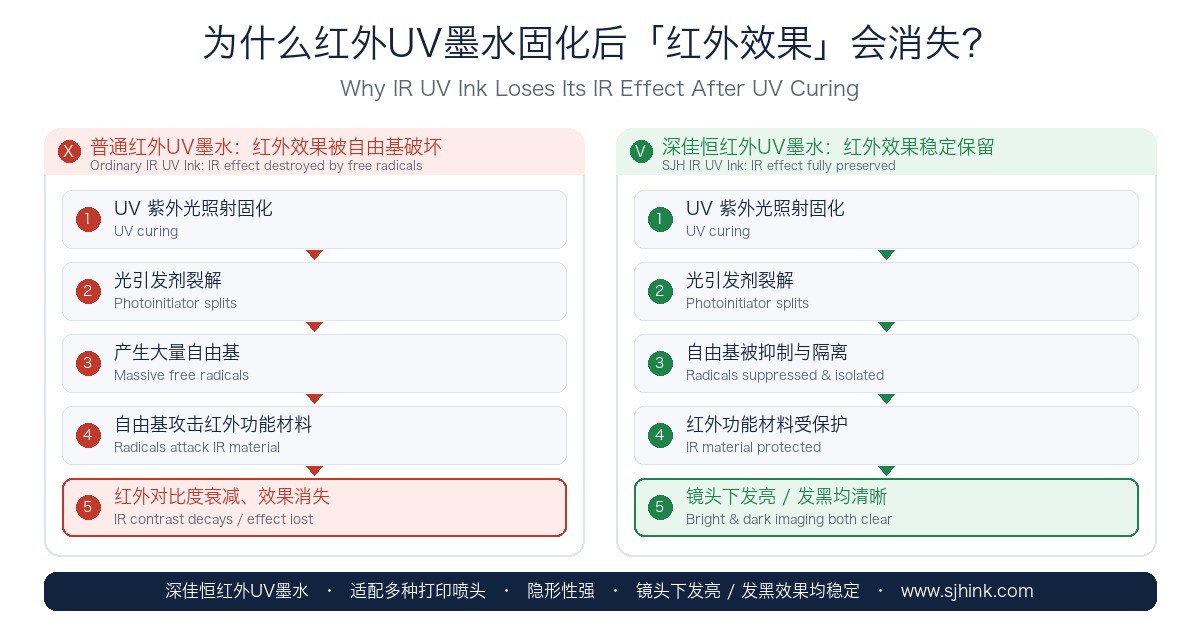
Most IR UV inks lose their infrared effect – partially or completely – during UV curing. The root cause is not the infrared material itself. When the photoinitiator in a UV ink absorbs ultraviolet light it splits into a large number of free radicals. Those radicals drive the resin cross-linking that cures the ink – but they also attack the infrared-absorbing or infrared-emitting material, quenching the very response the ink was designed to deliver. In short, the free radicals block the infrared material’s effect.
Our infrared UV ink was reformulated specifically to solve this problem. Its IR performance is not affected by the free radicals generated during UV curing: the effect is consistent before and after curing, imaging is clear in both bright (emissive) and dark (absorptive) IR camera modes, covertness is excellent, and the ink is compatible with a wide range of printer printheads.
1. Why “IR effect disappears after UV curing” is an industry-wide problem
An IR UV ink has to satisfy two requirements that pull against each other: it must cure under UV light, and it must preserve an infrared function that is highly vulnerable to free radicals.
The curing mechanism of any UV ink depends on radicals: UV light hits the photoinitiator, the photoinitiator splits, radicals are generated, and those radicals initiate cross-linking of acrylate monomers and oligomers until the film is cured. Radicals are the engine of UV curing – and they are also extremely reactive chemical intermediates. Most infrared absorbers and infrared fluorescent / up-conversion materials (especially organic dye-based IR materials) are highly sensitive to radicals. Once attacked, their IR performance degrades or disappears entirely.
This is why customers so often report the same experience: the print looks perfect on press, but after passing the UV curing lamp the infrared pattern becomes faint, patchy, or completely invisible under an IR camera.
2. How free radicals “eat” the IR effect – four failure pathways
When an IR effect disappears, it usually comes down to one or more of the following mechanisms:
| What you observe | Mechanism | Consequence |
|---|---|---|
| Good IR effect on press, but faint or gone after UV curing | Free radicals react chemically with the IR material – they add onto the conjugated structure of the IR absorber/emitter or take part in oxidation-reduction reactions, destroying the structure responsible for the IR response | Absorption or emission intensity drops, or the peak shifts; the IR response weakens |
| Pattern looks dim under the IR lamp, low contrast, blurred edges | Excited-state quenching – radicals drain the energy the IR material has absorbed via energy or electron transfer, lowering the luminescence quantum yield | Reduced brightness and signal-to-noise ratio; the code becomes hard to read |
| Whole IR background glows, pattern “drowns” in the background | Residual photoinitiator fragments create a background signal – leftover photoinitiator fragments contribute background absorption or weak fluorescence in the IR band | Contrast is compressed; read rate of the invisible code falls |
| Effect keeps deteriorating days after printing (dark decay) | Residual active species keep reacting – leftover radicals and unreacted monomers migrate and continue reacting inside the film | The ink passes final inspection at the factory but has already failed by the time it reaches the end user |
In addition, the cross-linking shrinkage and polarity change caused by UV curing can reduce the dispersion stability of the IR material, leading to local agglomeration or exudation – seen as mottling, uneven dots and localised failure across the print.
3. Why some IR UV inks work on press but fail a few days later
This is the delayed version of the free-radical problem, and the most easily overlooked trap.
UV curing takes milliseconds. Once the cross-linked network forms, a proportion of residual radicals and unreacted reactive diluents remains trapped inside the film. They do not vanish – they migrate slowly over hours or days and continue to react with the IR material, so performance keeps dropping. That is why some IR UV inks pass inspection at the printing house yet cannot be detected at all once they reach the end customer.
So when evaluating an IR UV ink, never look only at “does it work straight off the press”. Look at two data sets: immediate post-cure performance, and performance retention after storage.
4. Our approach: making the IR effect immune to free radicals
Adding more infrared material is not the answer – the more you add, the worse the viscosity, jetting stability and cost become. The correct approach is to reduce, at the source, the damage free radicals can do to the IR functional material. Our formulation addresses this along four axes:
- Select IR functional materials that are insensitive to free radicals. Rather than organic dye-type IR materials that are easily attacked by radical addition or oxidation, we use material routes that remain stable in a radical-rich environment – solving the problem at its origin.
- Protect the IR material. Surface encapsulation and carrier-loading technologies build an isolating layer between the IR functional material and the resin system, so radicals cannot easily reach and attack the material itself.
- Optimise the photoinitiation and curing system. By tuning photoinitiator type and ratio to match the wavelength and energy of UV / LED-UV curing sources, we achieve full film cure while keeping the residual radical concentration in the system low.
- Suppress residual active species. Stabilisation chemistry inhibits the post-cure reaction of residual radicals and unreacted monomers, substantially improving performance retention after storage – i.e. suppressing “dark decay”.
The result: SJH infrared UV ink keeps its IR performance stable before and after UV curing. Bright (emissive) imaging is clear, and dark (absorptive) imaging shows strong contrast – both can be reliably detected by IR cameras and code readers. At the same time, covertness under visible light is excellent, so packaging appearance is unaffected.
5. More than “the effect stays” – compatibility with a wide range of printheads
IR functional materials are typically dense, prone to settling and hard to keep within a tight particle-size distribution – which is exactly why many IR inks “work in the lab but clog the head on the machine”. Our ink solves the jetting side of the problem as well:
- Nano-scale dispersion and particle-size control – maximum particle size and distribution are tightly controlled to reduce nozzle clogging and filter deposition;
- Matched viscosity and surface tension – rheology is tuned to the printhead’s operating parameters for continuous jetting, clean break-off and no satellites;
- Anti-settling, stable on standby – resists settling and caking after standing, supporting intermittent printing and short standby with less purging waste;
- Multi-platform compatibility – compatible with a range of mainstream industrial piezoelectric printhead platforms. The exact printhead models, waveform parameters and ink-delivery requirements are best confirmed jointly with your equipment during the sampling stage;
- Compatible with conventional printing processes – beyond inkjet, the ink is also available for screen, offset, flexo and gravure printing, with a dedicated ink system for each process.
6. SJH infrared UV ink vs ordinary IR UV ink
| Comparison | Ordinary IR UV ink | SJH infrared UV ink |
|---|---|---|
| IR effect after UV curing | Often decays, fades or disappears | Stable before and after curing |
| Impact of free radicals | Radicals destroy the IR material; performance is unpredictable | Formulation suppresses radical attack on the IR material |
| Retention after storage | Prone to dark decay – passes at the factory, fails at the customer | Performance stays stable after storage |
| IR imaging mode | Usually absorptive only, highly background-dependent | Clear in both bright (emissive) and dark (absorptive) modes |
| Covertness | May show a tint or mottling under visible light | Highly covert; no visible trace |
| Printhead compatibility | Settles easily, clogs nozzles, poor machine stability | Compatible with many printheads; stable continuous jetting |
| Process compatibility | Usually limited to one process | Inkjet, screen, offset, flexo and gravure |
7. Where it is used
- Invisible QR codes / item-level traceability – an IR invisible code is overprinted on the packaging; production lines and inspectors read it with IR equipment, cross-verifying against the visible QR code;
- Anti-counterfeiting for tobacco, alcohol, pharmaceutical and cosmetics packaging – highly covert without altering the packaging design; a mainstream covert security solution for premium cigarette packs, wine labels, pharmaceuticals and cosmetics;
- Covert marking of electronic and automotive components – invisible batch and serial numbers inkjetted onto parts for anti-diversion, anti-counterfeiting and full traceability;
- Document and ID security – tickets, certificates and ID cards where covertness and uniqueness are critical;
- Multi-layer security combinations – can be overprinted with OVI optically variable ink, thermochromic ink and UV fluorescent ink to build a layered security system.
8. FAQ
Why does the IR effect disappear after an IR UV ink is UV cured?
Because UV curing depends on free radicals generated when the photoinitiator splits. Those same radicals react with the infrared absorbing or emitting material in the ink, or quench its excited state, destroying its IR response. Residual photoinitiator fragments also add background signal in the IR band, further reducing contrast. The IR effect therefore decays – or disappears – as the ink cures.
Do all IR UV inks lose their effect?
No. This is a formulation design problem, not an inevitable consequence of the mechanism. By selecting IR functional materials that are stable against radicals, encapsulating the material, optimising the photoinitiation system and suppressing residual active species, the IR effect can be kept essentially unchanged before and after UV curing. This is the technical route our infrared UV ink follows.
How can I tell whether an IR UV ink has been damaged by UV curing?
Run two simple comparisons. First, take the same ink film and compare “tested immediately after curing” with “tested 3-7 days after curing”, looking at brightness and contrast under an IR camera. Second, compare the clarity and read rate of the same pattern before and after curing. If performance drops noticeably after storage, the ink suffers from radical-induced dark decay.
Why is SJH infrared UV ink unaffected by free radicals?
Four reasons: we select IR functional materials that are insensitive to radicals; we build an isolating layer between the IR material and the resin using encapsulation and carrier loading; we optimise the photoinitiation and curing system to lower residual radical concentration; and we use stabilisation chemistry to inhibit post-cure reactions of residual active species. The IR material is therefore protected throughout curing, and its performance is preserved.
What do “bright” and “dark” IR imaging mean?
They are the two contrast modes in infrared imaging. Bright refers to the emissive type: after IR excitation the material emits a signal captured by the camera, so the pattern lights up against a dark background. Dark refers to the absorptive type: the material strongly absorbs a specific IR band, so the pattern appears dark against a bright background. SJH infrared UV ink images clearly in both modes, so customers can choose according to their detection equipment and application.
Which printer printheads is the IR UV ink compatible with?
It is compatible with a range of mainstream industrial piezoelectric printhead platforms. Because printhead models, waveform parameters and ink-delivery systems vary widely, the exact match is best confirmed together with your equipment during sampling; we can supply a dedicated formulation with adjusted parameters.
Is the IR UV ink visible under normal light?
No. SJH infrared UV ink is highly covert under visible light with no visible trace, so it does not affect packaging appearance or design. It can only be detected with an IR light source of the matching wavelength together with an IR camera or code reader.
How do I request samples, and how are they charged?
Tell us your substrate, printing process (inkjet, screen, offset, flexo or gravure) and required detection wavelength, and we will recommend or customise a formulation. Samples are charged by weight with flexible minimum quantities, and printed proofs are available free of charge so you can verify the IR and covertness performance before placing an order.
9. About SJH Ink
Shenzhen Sojhonink Co., Ltd. specialises in the R&D and production of anti-counterfeiting inks. The company is a member of the RadTech China association, has an annual capacity of nearly 1,000 tonnes, and its products comply with EN71.3, REACH and other environmental standards. Our main product lines include:
- Infrared UV ink / IR excitation ink / IR absorbing ink – customisable for 850 / 940 / 980 nm and other bands, suitable for inkjet printing invisible QR codes and item-level traceability codes;
- UV invisible fluorescent ink – detected with a UV lamp, for tickets and documents;
- OVI optically variable ink (OVMI / chameleon ink) – angle-dependent color shift, banknote-grade security;
- Water-based thermochromic ink / photochromic ink / glow-in-the-dark ink – obvious security effects verifiable by eye.
We support inkjet, screen, offset, flexo and gravure printing, and can customise formulations and provide printed proofs according to substrate, wavelength and equipment.
- Website: www.sjhink.com
- Tel: +86 13510998453 / +86 13510514531
- Email: sz_qhy@hotmail.com
- Address: No.14 Fuxing Road, Pinghu, Longgang District, Shenzhen, China
If you are evaluating an infrared covert security or covert marking solution, contact us to send your substrate for a real test. See our product centre for more, read the related articles Infrared Absorbing UV Ink for Anti-Counterfeiting & Traceability and IR Excitation Ink Selection Guide, or contact us for pricing and technical support.
Published by Shenzhen Sojhonink Co., Ltd. Please credit the source when republishing.