Selection, detection, printing and ordering — answered.
What is the most obvious difference between UV invisible ink and normal ink?
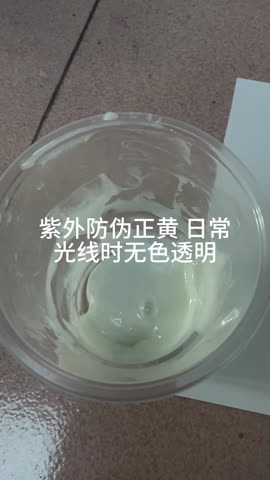
Appearance. Normal ink leaves a clearly visible printed image. UV invisible ink is colourless and transparent in normal light, leaving almost no trace, and only shows its fluorescent pattern under 254/365 nm UV.
How is UV invisible ink checked? Does it need special equipment?
No special equipment. An ordinary banknote detector or a UV torch reveals it within seconds, so consumers can carry out a first-line check themselves.
Why can normal ink not protect against copying while UV invisible ink can?
Normal ink can be scanned and reproduced. The fluorescent compound in UV invisible ink is hard to replicate, and counterfeiters often do not even realise a security mark is present. It can also be combined with QR identity codes or OVI into a multi-layer system.
What substrates and processes does UV invisible ink work with?
Offset, screen, flexo, gravure and inkjet processes, on paper, plastic, metal, glass, ceramics and textiles.
What should I ask a supplier before ordering UV invisible ink?
Four points: whether the fluorescence colour can be customised (red/yellow/green/blue); the excitation wavelength (254 or 365 nm, or dual); compatibility with your existing press; and compliance with EN71.3 and REACH.