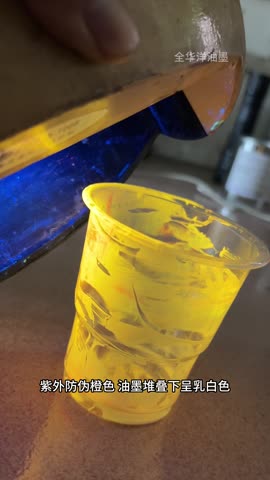
SJH UV fluorescent orange ink: milky white in daylight, reveals orange fluorescence under UV — suitable for UV offset printing.
UV invisible ink (UV fluorescent ink) in offset and rotary printing often faces: ink misting, blurry patterns, weak fluorescence, poor heat resistance and poor light fastness. SJH Ink shares the causes and solutions.
1. Ink Misting
Caused by low viscosity and poor equipment calibration. Solution: optimize viscosity/formulation for high-speed presses and calibrate roller gaps and pressure.
2. Blurry Patterns
Caused by poor resin compatibility and unbalanced additives. Solution: use high-film-forming resin with properly balanced wetting/leveling/dispersing agents for crisp dot reproduction.
3. Weak Fluorescence
Fluorescence intensity order: blue > red > yellow > green. Dark substrates, thin ink film and low rare-earth fluorescent content weaken the effect. Solution: thicker film on dark substrates and higher-purity rare-earth fluorescent materials.
4. Poor Heat & Light Resistance
Depends on the resin system and fluorescent powder. Solution: high-heat, high-aging-resistant resin with high-grade rare-earth fluorescent materials.
SJH Ink UV Invisible Ink Advantages
Heat resistant: 220°C for 10 hours without fading or delamination
Light fastness: grade 4+
Optimized for offset/rotary presses: no misting, precise dot reproduction
High rare-earth fluorescent content for bright, uniform multi-color glow
Selection, detection, printing and ordering — answered.
Why does UV invisible ink mist or fly during printing?
Two causes. First, the ink viscosity is too low and flow too high to suit high-speed presses, so mist sprays off the rollers. Second, roller gaps and printing pressure are set without matching the ink, which amplifies the effect.
Blurred, soft-edged print — is it the press or the ink?
Almost always the ink formulation. A poorly matched base resin with weak film-forming behaviour cannot lay down an even, dense ink film; badly proportioned wetting, levelling and dispersing additives further break up flow, blurring dots and the whole image.
What can be done when fluorescence looks weak?
Start with the colour: industry-wide fluorescence strength runs blue > red > yellow > green. Then check the process — dark substrates swallow fluorescence and need a thicker ink film — and finally raise the content of high-purity rare-earth fluorescent material in the formula.
How much heat can UV invisible ink take?
SJH UV invisible ink withstands 220 °C for 10 hours continuous with no fading, no ink lift and no loss of fluorescence, which covers high-temperature post-press operations.
Will it fade outdoors over time?
That depends on the resin system and the weather resistance grade of the fluorescent pigment. SJH product reaches lightfastness grade 4 or above, resisting ageing, fading and loss of gloss in long-term sunlight. Generic low-end resin with low-grade pigment will lose fluorescence instead.