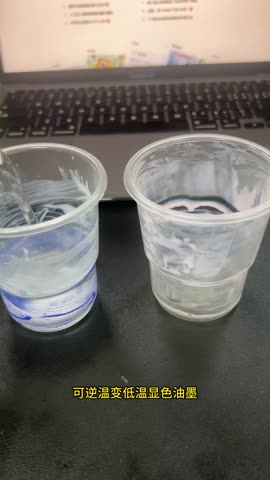
SJH thermochromic ink color-change test: left cup colored at low temperature, right cup faded after warming — verifies trigger temperature and uniformity.
Thermochromic (heat-sensitive) ink in screen, gravure and pad printing often faces: sluggish color change, wrong trigger temperature, uneven color and poor adhesion. SJH Ink shares the causes and solutions.
1. Sluggish Color Change
Caused by mismatched trigger temperature, thin ink film or low microcapsule content. Solution: choose the right trigger level (5/18°C low, 28/31/37/40°C ambient, 65/70/80°C+ high), increase film thickness and raise active microcapsule content.
2. Wrong Trigger Temperature
Batch variation, excessive oven temperature and poor storage shift the trigger point. Solution: stable batches with ±2°C tolerance, control drying temperature, avoid long-term high-temperature storage.
3. Uneven Color
Uneven film thickness, substrate absorption differences and poor dispersion. Solution: optimize leveling/dispersion, use substrate-specific formulas, adjust printing parameters.
4. Poor Adhesion
Common on smooth plastics (PVC/PC/PP/PET). Solution: corona/degrease pretreatment, matching resin systems, or a primer coat.
SJH Ink Advantages
Custom triggers 5-80°C with ±2°C tolerance
Reversible or irreversible
Water-based, RoHS/REACH compliant
Screen, gravure, flexo, pad printing on paper/plastic/metal
Selection, detection, printing and ordering — answered.
Thermochromic ink reacts slowly — how do I diagnose it?
Three causes: the trigger temperature is a poor match for the service environment (the change naturally slows when ambient temperature sits close to the trigger point); the ink film is too thin so the colour change is weak; or the microcapsule content is too low. Fix by re-selecting the temperature band, increasing film thickness and adjusting the formula.
What if the trigger temperature is inaccurate?
Usually batch variation in the thermochromic material, drying temperature, or storage conditions. A hot drying tunnel damages the microcapsules and shifts the trigger point, and high storage temperatures age the material. Use a consistent, process-stable ink, keep drying temperature in range, and avoid long-term hot storage. SJH tests every batch before dispatch, holding deviation within plus or minus 2 °C.
Why does the colour change unevenly or look mottled?
Most often uneven ink film thickness, differing absorbency across the substrate, or poor additive balance leaving the thermochromic material unevenly dispersed. Improve levelling and dispersion, use a dedicated formula for high-absorbency substrates such as paper and PVC, and adjust printing pressure and mesh parameters for a consistent film.
Thermochromic ink rubs off glossy plastic — what fixes it?
Glossy plastics such as PVC, PC, PP and PET have low surface energy, so a mismatched resin system will not adhere. Pre-treat the substrate (corona, degreasing), select a resin system matched to the plastic, and where necessary print a primer coat before the thermochromic layer.
What trigger temperature range does thermochromic ink cover?
Any band from 5 to 80 °C can be customised, with every batch tested before dispatch and deviation held within plus or minus 2 °C. Reversible and irreversible versions are both available.