What Is Thermochromic Ink? Heat-Sensitive Ink Guide
Home › News › What Is Thermochromic Ink? Heat-Sensitive Ink Guide
2026-08-04 published · updated
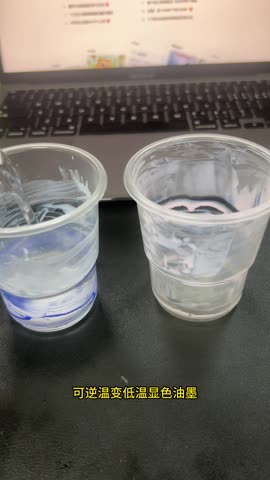
SJH reversible thermochromic ink (low-temp blue): left cup shows the blue activated state, right cup shows the faded state after warming.
Thermochromic ink (heat-sensitive ink) changes color with temperature for security, warning and fun packaging.
What It Is
Triggered by hand warmth, hot water or body heat — no equipment needed. Color develops, disappears or changes with temperature.
Key Features
Custom triggers: 5/18°C low, 28/31/37/40°C ambient, 65/70/80°C+ high
Reversible or irreversible
Water-based, RoHS/REACH compliant
Screen, gravure, flexo, pad printing
Applications
Beverage temperature labels, tamper-evident seals, medicine temperature indicators, cultural products.
SJH Ink offers custom thermochromic ink with free printed proofs. Tel 13510998453, www.sjhink.com.
Frequently Asked Questions
Selection, detection, printing and ordering — answered.
What is thermochromic ink and what effects can it produce?
Also called heat-sensitive or temperature-indicating ink, it can develop colour, disappear or change colour as temperature rises or falls. Verification is intuitive and needs no equipment, which is why it is used for security, warning, packaging, toys and creative products.
How is thermochromic ink triggered? Does it need equipment?
No equipment. Hand warmth, hot water or body temperature is enough, and the change is obvious at a glance.
What trigger temperature ranges are available?
Low range at 5 °C and 18 °C; ambient range at 28, 31, 37 and 40 °C; high range at 65, 70 and 80 °C and above, selected according to the use scenario.
What is the difference between reversible and irreversible thermochromic ink?
Reversible grades return to their original colour when the temperature returns, suiting repeated verification and interactive effects. Irreversible grades stay changed, suiting one-time temperature indication and evidence retention. Both are available.
What substrates and processes does thermochromic ink work with?
Screen, gravure, flexo and pad printing; on plastics such as PVC, PC, PP and PET, plus paper and metal. Water-based grades meet RoHS and REACH.