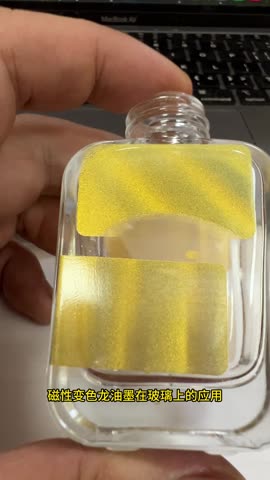
Optically Variable Ink (OVI), commonly called “chameleon ink” in the industry, is a security ink based on thin-film optical interference. Its defining feature: the printed image visibly changes color with viewing angle — one color viewed straight-on, another when tilted, much like a chameleon shifting its body color.
Because this angle-dependent color effect cannot be reproduced by photocopying, scanning or photography, OVI is widely recognized as one of the highest-barrier overt security features, used on banknotes, passports, tax stamps and premium packaging.
1. How It Works: Thin-Film Optical Interference
The heart of OVI lies in multilayer thin-film interference (MLI) pigments. Each particle is a microscopic optical stack with a typical three-layer structure:
- Base layer: highly reflective metal (e.g. aluminum/chromium) — strong reflective base
- Spacer layer: transparent dielectric (e.g. magnesium fluoride MgF2) — determines the interference wavelength
- Top layer: semi-transparent partial reflector — creates multi-reflection and interference
When visible light strikes the pigment, rays are reflected at multiple interfaces and interfere. Different wavelengths are enhanced or cancelled at different incidence angles, producing a continuously varying interference color.
In one sentence: angle changes → optical path difference changes → the reinforced wavelength changes → the color changes.
2. Common Color-Shift Pairs
- Green to Blue
- Gold to Green
- Purple to Green
- Red to Green
- Cyan to Purple
- Green to Purple
High-contrast pairs are instantly recognizable under natural light with no equipment.
3. Why OVI Is Extremely Hard to Counterfeit
- Cannot be copied: scanning and photocopying capture a single viewing angle and cannot capture the dynamic color change.
- High production barrier: vacuum deposition requires dedicated high-vacuum coating equipment and precise film-thickness control.
- Controlled raw materials: high-grade OVI pigments come from very few vendors (e.g. SICPA) under tight control.
- Democratized verification: anyone can tilt the product and verify authenticity — a public, self-policing security mechanism.
4. Printing Processes
- Gravure: banknote-grade — e.g. early Euro denomination numerals.
- Screen printing: the most common — for tobacco/alcohol packaging, security labels, bottle decoration.
- Flexo: for large continuous areas.
- Pad printing: for small, irregular surfaces.
5. Applications
- Banknotes, passports, ID documents
- Tax stamps, invoices, securities
- Premium tobacco, alcohol, cosmetics and luxury packaging
- Security labels, tamper seals, hang tags
- Brand licensing marks, collectibles
6. SJH OVI Chameleon Ink Solutions
SJH Ink offers a mature OVI chameleon ink series: multiple color-shift pairs, adapted for offset, gravure, screen, flexo and pad printing, combinable with UV-invisible and IR-excited series for multi-layer security; custom formulations supported.
About SJH Ink
Shenzhen SJH Ink Co., Ltd. (est. 2002, 14 Fuxing Road, Pinghu, Longgang District, Shenzhen) specializes in OVI, UV invisible, thermochromic and IR excitation inks. Free samples. Tel 13510998453, www.sjhink.com.