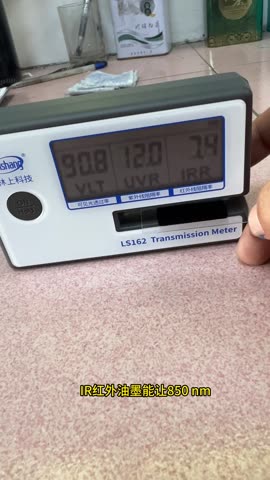
1. Why Brands Need IR-Absorbing UV Ink
Counterfeit products cause billions of dollars in direct losses to brand owners every year. Industries such as tobacco, liquor, pharmaceuticals, cosmetics, food, electronics and luxury goods have an ever-growing demand for anti-counterfeit traceability. Traditional visible anti-counterfeit features (e.g. laser labels, thermochromic inks) are relatively easy to replicate, while public QR codes can be copied and re-printed.
IR-absorbing UV ink offers a differentiated path: using infrared light to “read” invisible anti-counterfeit information. It combines the high-efficiency printing performance of UV inks with the covert identification function of infrared materials, and is becoming one of the fastest-growing ink categories in the anti-counterfeit traceability market.
2. What Is IR-Absorbing UV Ink? How Does It Work?
IR-absorbing UV ink is a specialty anti-counterfeit ink made by dispersing infrared functional materials into a UV-curable resin system. It has two layers of properties:
- Printing property: UV ink characteristics — cures instantly under UV light, fast drying, abrasion-resistant, solvent-resistant, good adhesion, suitable for high-speed printing lines;
- Functional property: absorbs or is excited by specific infrared wavelengths, enabling covert identification.
There are two mainstream types:
| Type | Principle | Detection Method | Typical Wavelength |
|---|---|---|---|
| IR-Absorbing (Detection) | IR absorbers in the ink strongly absorb specific wavelengths, creating light/dark contrast | IR light source + IR camera/reader imaging | 850nm, 940nm, 980nm |
| IR Up-Conversion (Excitation) | Rare-earth doped up-conversion materials absorb IR light and emit visible light | Visible luminescence after IR illumination | Excitation 980nm, emission green/red/blue |
In simple terms: the absorbing type is like “invisible ink + special glasses” — invisible to the naked eye, revealed instantly by an IR device; the up-conversion type is like an “energy converter” — the pattern lights up by itself under IR light.
3. Typical Applications in Anti-Counterfeit Traceability
- Invisible QR codes / dot matrix codes: print a visible QR code together with an invisible IR-absorbing code on the package. Consumers scan the visible code to verify authenticity, while production-line and inspection staff read the invisible code with IR devices. Dual-code verification makes counterfeiting extremely difficult.
- One-product-one-code traceability: each product carries a unique serial number printed as an invisible IR code, enabling full “production—logistics—sales” tracking without affecting package appearance.
- Invisible serial/batch codes: printed in hidden positions or under labels for channel audits and diversion (grey-market) tracking — invisible to the naked eye, preventing label-swapping fraud.
- Multi-layer combined anti-counterfeit: IR-absorbing UV ink is often stacked with OVI color-shifting ink, thermochromic ink and UV fluorescent ink to form a “multi-layer anti-counterfeit wall”.
- High-end certificates & documents: for certificates, tickets and tobacco monopoly marks with high requirements for covertness and uniqueness.
4. Advantages of the Process
4.1 Invisible Printing, Package Design Unaffected
IR-absorbing ink is nearly invisible under visible light, so brands keep package aesthetics intact without adding an extra “patch” like anti-counterfeit labels — ideal for premium cosmetics, liquor and electronics packaging.
4.2 High Covertness, Difficult to Counterfeit
The position, shape and wavelength parameters of the anti-counterfeit feature are corporate secrets. Even with a genuine product in hand, counterfeiters cannot locate the feature with the naked eye, let alone reverse-engineer it — this is the core advantage of IR anti-counterfeit ink.
4.3 Large Information Capacity for Real Traceability
Invisible IR codes can carry QR codes, serial numbers and other data. Combined with a database, they enable one-product-one-code, full-chain traceability — anti-counterfeit and traceability solved at once.
4.4 Compatible with High-Speed UV Printing
UV inks cure in milliseconds and can be directly adapted to offset, screen, flexo and gravure printing, making them suitable for mass production lines without slowing down production pace.
4.5 Fast Detection for Line Inspection
IR detection is second-level. Customs, inspection agencies and distributors can use handheld readers for rapid spot checks — no chemical reagents or destructive testing required.
4.6 Environmentally Compliant
UV inks are solvent-free with low VOC, meeting modern environmental printing requirements. SJH Ink’s IR excitation ink can be formulated to EN71.3 and REACH standards for export to the EU and other markets.
4.7 Combinable with Other Anti-Counterfeit Technologies
Compatible and recommended to be stacked with OVI color-shifting ink, thermochromic ink and UV fluorescent ink to form combined anti-counterfeit solutions — a key element of multi-level security systems.
5. Disadvantages and Limitations
5.1 Dedicated Detection Equipment Required
This is the biggest barrier. IR anti-counterfeit features cannot be identified by the naked eye or ordinary counterfeit-detector lamps. Brands, distributors and terminals all need IR light sources and readers — equipment purchase and staff training are extra costs.
5.2 End Consumers Cannot Easily Verify
Consumers do not have IR devices, so they cannot verify authenticity by themselves and must rely on a “scan entry” or merchant verification. Therefore IR anti-counterfeit is usually combined with a visible QR code rather than used alone as a consumer-facing verification method.
5.3 Higher Ink and Equipment Costs
IR absorbers and rare-earth up-conversion materials are expensive, making the ink pricier than ordinary UV ink; IR readers (light source + camera) also cost far more than ordinary barcode scanners. IR anti-counterfeit ink suits high-value products with strong anti-counterfeit demand; cost-effectiveness is limited for low-margin fast-moving consumer goods.
5.4 Higher Printing Process Requirements
The addition of IR materials affects the ink’s rheology, coverage and curing response. UV curing energy (mercury lamp or LED-UV wavelength and power), printing speed and film thickness must be tuned — higher operator skill is required, and close collaboration with the ink manufacturer during sampling is essential.
5.5 Covertness Is a Double-Edged Sword
Because the feature is invisible, consumers may not even know the package has an anti-counterfeit feature. Brands need instructions or scan pages to guide users — an education/marketing cost that cannot be ignored.
5.6 Extra Compliance Verification for Food Contact
For food or pharmaceutical direct-contact packaging, IR functional materials must pass migration testing and regulatory compliance (e.g. China GB 9685, EU REACH). Some materials are restricted in food-contact scenarios — always run a compliance assessment before selection.
5.7 Industry Standards Not Fully Unified
Absorption wavelengths and reader specifications vary among manufacturers, and cross-vendor interoperability still needs verification. Brands should lock the ink-and-equipment pairing when finalizing a solution to avoid compatibility risks.
6. Comparison with Other Anti-Counterfeit Inks
| Item | IR-Absorbing UV Ink | UV Fluorescent Ink | OVI Color-Shifting Ink | Thermochromic Ink |
|---|---|---|---|---|
| Visibility | Invisible | Visible under UV light | Color-shifting, visible | Color-changing, visible |
| Detection | IR device | UV lamp | Visual tilting | Visual/heating |
| Data Capacity | Codes + traceability | Fluorescent patterns | None/limited | None |
| Counterfeit Difficulty | High | Medium | Medium-high | Medium |
| Main Cost | Ink + equipment | Ink | Ink | Ink |
| Typical Use | One-product-one-code, tobacco/liquor/pharma | Tickets, documents | Currency, premium packaging | Anti-counterfeit + temperature indication |
Conclusion: IR-absorbing UV ink excels in data capacity and covertness, ideal for “traceability + covertness” scenarios; visible anti-counterfeit (OVI, thermochromic) suits scenarios where consumers need direct visual verification. Mature solutions often combine both.
7. How to Choose IR-Absorbing UV Ink — Selection and Sampling Tips
- Define the application: tobacco/liquor packaging, pharmaceutical traceability, cosmetics or certificates? Do you need one-product-one-code? Determine whether you need the “absorbing” or “up-conversion” type.
- Confirm substrate and printing method: paper, PET, PVC or metal? Offset, screen or flexo? Different combinations need different formulations.
- Lock the wavelength and equipment: confirm the detection wavelength (850/940/980nm) and matching readers; ask the ink manufacturer to provide a test unit or recommended equipment model.
- Sample first, then mass-produce: anti-counterfeit inks must be validated on real machines for curing speed, adhesion, abrasion resistance and weatherability before mass production.
- Request compliance documents: ask for SGS/REACH reports and MSDS (Material Safety Data Sheet) — especially important for exports.
- Request free samples: reputable anti-counterfeit ink manufacturers usually offer free samples and custom sampling. Verify before paying to reduce trial-and-error cost.
8. FAQ
Q1: Is IR-absorbing UV ink visible under visible light?
IR-absorbing ink is essentially invisible or extremely hard to notice under visible light — that is its core value as covert anti-counterfeit. The up-conversion type is also invisible without IR illumination.
Q2: What equipment is used to detect IR anti-counterfeit codes?
An IR light source matching the ink wavelength (e.g. 850/940/980nm IR LEDs) plus an IR camera or dedicated reader. Handheld readers suit distributor and inspection scenarios; production lines can use inline detection cameras.
Q3: Can IR-absorbing UV ink be used for food packaging?
It depends. For direct food-contact packaging, IR functional materials must pass migration testing and comply with regulations such as GB 9685 and REACH. Confirm compliance with the ink manufacturer during the selection stage.
Q4: What is the difference between IR-absorbing UV ink and UV fluorescent ink?
Both are covert anti-counterfeit inks, but they work in different wavelength ranges: fluorescent ink is excited by UV lamps (around 365nm), with lower equipment barriers; IR ink is detected by infrared light, offering higher covertness and larger data capacity (codes and traceability), at a higher equipment cost.
Q5: Can IR-absorbing UV ink be combined with other anti-counterfeit inks?
Yes, and combination is recommended. IR-absorbing UV ink is often stacked with OVI color-shifting ink, thermochromic ink and UV fluorescent ink to form multi-layer anti-counterfeit — the mainstream approach for high-end security.
Q6: Is IR-absorbing UV ink expensive? What is the MOQ?
IR anti-counterfeit ink costs more than ordinary UV ink due to expensive functional materials; the exact price depends on formulation and order volume. Reputable manufacturers (such as SJH Ink) offer free samples and custom sampling — verify first, then discuss bulk pricing.
Q7: Can invisible IR codes resist “copy printing”?
Ordinary copiers and scanners cannot reproduce invisible IR codes. Only manufacturers who know the wavelength parameters and have the dedicated ink and equipment can replicate them — and parameters can be changed per batch, making reverse engineering nearly impossible.
Q8: What is the shelf life and storage condition of IR-absorbing UV ink?
UV inks should be stored away from light, sealed, in a cool place; shelf life is typically 12 months (check the manufacturer’s specifications). Keep containers tightly sealed after opening to avoid dust and skinning.
9. About Shenzhen SJH Ink Co., Ltd.
Shenzhen SJH Ink Co., Ltd. specializes in the R&D and production of anti-counterfeit inks. It is a member of the China Radiation Curing Branch (中国辐射固化分会) with an annual output of nearly 1,000 tons. Product lines include:
- IR excitation ink / IR-absorbing UV ink: custom wavelengths at 850/940/980nm, printable as invisible QR codes and one-product-one-code
- UV invisible fluorescent ink: UV-lamp detectable, for tickets and certificates
- OVI optically variable ink (color-shifting / chameleon ink): angle-dependent color change, currency-grade security
- Water-based thermochromic ink / photochromic ink / glow-in-the-dark ink: intuitive visible anti-counterfeit
The company supports offset, screen, flexo and gravure printing, with custom formulations, free samples and sampling verification based on substrate and wavelength. Products comply with EN71.3 and REACH environmental standards.
- Website: www.sjhink.com
- Tel: +86 13510998453
- Email: sz_qhy@hotmail.com
- Address: No.14 Fuxing Road, Pinghu, Longgang District, Shenzhen, China
If you are planning an anti-counterfeit traceability solution, welcome to request samples to verify the actual performance of IR-absorbing UV ink. Browse our product center or contact us for a quote.
Published by Shenzhen SJH Ink Co., Ltd. Reproduction with attribution required.