Have you ever wondered how banknote patterns, wine bottle seals or medicine package security codes prove they are genuine? One of the answers lies in the very ink they are printed with.
Security ink is a printing ink with special appearance, color or optical properties. It stays unobtrusive, yet can “prove its identity” at the critical moment — the most fundamental and widespread element in modern product anti-counterfeiting systems.
1. How Does Security Ink Work?
Imagine ordinary ink as a “painted coat”; security ink sews special mechanisms into that coat. These mechanisms usually fall into three categories:
- Invisible mechanisms: no anomaly under normal light, but hidden patterns or text appear when illuminated with a specific tool (e.g. UV lamp, IR lamp).
- Changing mechanisms: color changes with angle, temperature, humidity or other conditions. When you turn a package and the pattern shifts from green to purple, that is optically variable ink at work.
- Tangible mechanisms: distinguished by the ink’s tactile feel, magnetic properties and other physical characteristics — verified with a special detector pen.
2. Common Types of Security Ink
According to the anti-counterfeiting principle, mainstream security inks can be divided into the following categories:
| Type | Working Principle | Typical Feature |
|---|---|---|
| UV Fluorescent Ink | Emits visible fluorescence under UV lamp | Colorless or pale; reveals red, blue, green fluorescent patterns under UV |
| Thermochromic Ink | Color changes with temperature | Changes color when heated, recovers when cooled; often used for “touch-to-change” verification |
| Optically Variable Ink (OVI) | Shows different colors from different viewing angles | Color shifts with viewing angle, with a strong transition effect |
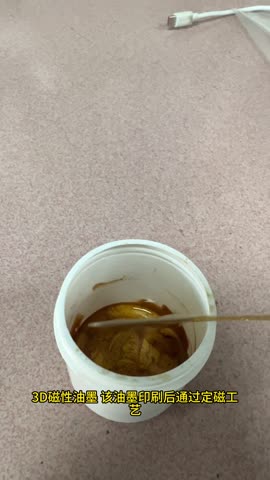
| Magnetic Ink | Contains magnetic materials readable by magnetic heads | Widely used for machine-readable security on banknotes and tickets |
| IR Security Ink | Shows special reaction under infrared light | Absorption or emission features under IR source; excellent concealment |
| Invisible Ink | Becomes visible only under specific conditions (light, heat, chemicals) | Invisible in daily use; revealed by dedicated tools or methods |
3. Where Is Security Ink Used?
- Currency & tickets: banknotes worldwide commonly combine OVI, magnetic ink, fluorescent ink and more.
- Certificates & credentials: security marks on ID cards, passports, degree certificates and business licenses.
- Brand products: packaging and labels for tobacco, alcohol, cosmetics, health products and electronics against counterfeiting.
- Important documents: anti-counterfeit printing and cross-page seals on contracts, invoices and receipts.
For brand owners, the value of security ink is that counterfeiters cannot easily reproduce it at low cost, while consumers and inspectors can do a preliminary check with the naked eye, touch or a UV lamp — no professional equipment needed.
4. Common Misconceptions About Security Ink
- Myth 1: “Security ink = absolute anti-counterfeiting.” Security ink is part of a security system, not a magic lock. Professional solutions usually combine ink + intaglio patterns + security codes to multiply the difficulty of forgery.
- Myth 2: “All security inks are expensive.” Not true. Regular types such as fluorescent ink and thermochromic ink are cost-effective for large-scale use; high-end optical security inks are reserved for high-value scenarios — choose as needed.
- Myth 3: “The more complex the mark, the better.” Security design must balance anti-counterfeiting strength with ease of verification — no matter how sophisticated a mark is, it is meaningless if consumers cannot verify it.
5. Conclusion
Security ink is a combination of technology and printing process, and the most accessible link in a product’s “identity proof”. It does not announce itself, yet it quietly protects the authenticity and trust of every transaction.
About SJH Ink
Shenzhen Sojhonink Co., Ltd. was founded in 2002 and is located at No.14 Fuxing Road, Pinghu, Longgang District, Shenzhen. For over 20 years we have specialized in R&D and production of security inks including UV fluorescent ink, thermochromic ink, optically variable ink (OVI chameleon), magnetic ink and IR excitation ink. Free printed proofs available — test before you order. Contact us at +86-13510998453 (Mr. Wang) or visit www.sjhink.com.